

The animals people come here for | How often we actually find them | Day and night outings | Something to see in every season
We'll Give You the Odds
Guests usually arrive with a picture in their heads of what the Amazon owes them, and the trip goes better when that picture is close to the truth, so we asked our guides to go through every animal on this page and say how often they really find it on a normal trip. Some of what follows is close to a certainty and you can plan around it, and some of it comes down to a good morning and a bit of luck, and knowing which is which before you get on the canoe is worth more than any photograph we could put here. You can read about the forest and the water these animals live in on our Cuyabeno Wildlife Reserve page.
The Five Animals People Most Hope to See
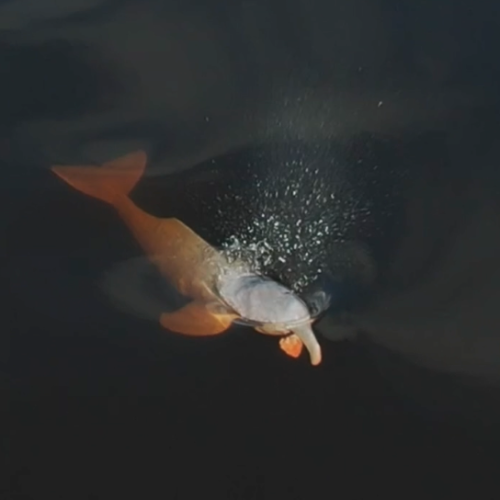
Pink Dolphin
It is the one almost everyone arrives hoping for.
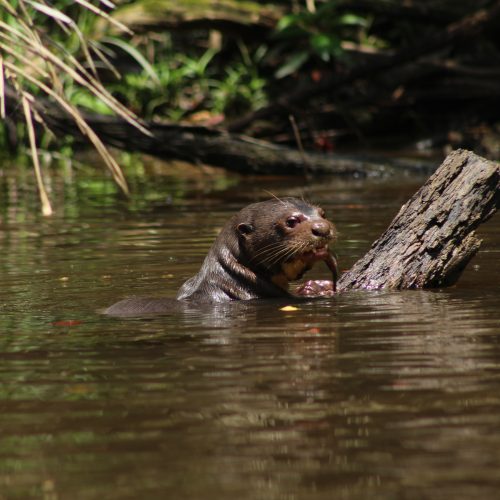
Giant Otter
The river wolf hunts in families, so you hear it first.
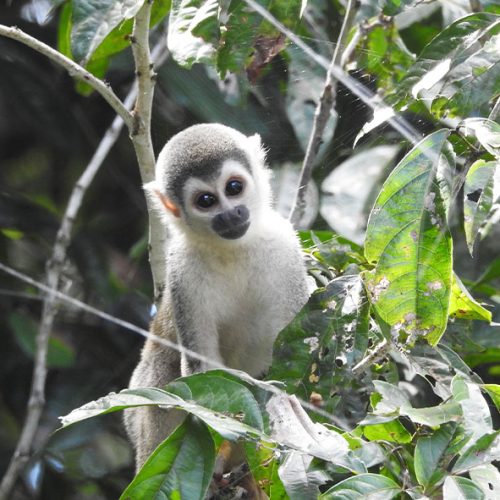
Squirrel Monkey
They travel in bold little troops along the water.
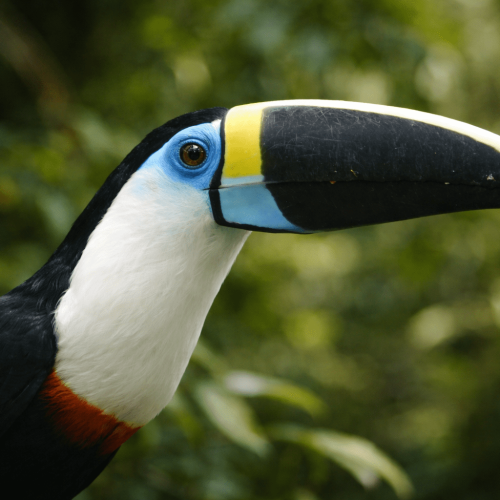
Toucan
It is the bird we are named after.
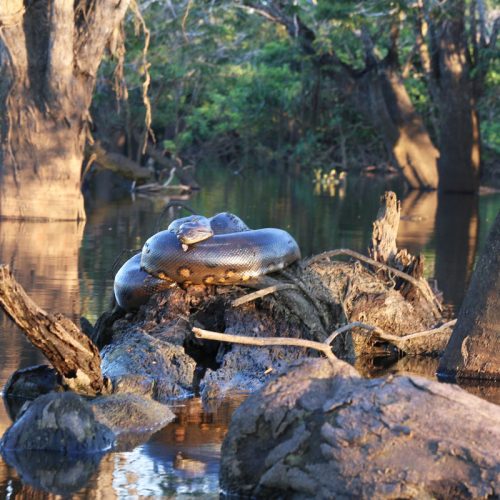
Green Anaconda
It is the one guests always ask about before they come.
What You'll Actually See
These numbers come from our own guides, who went through the list animal by animal for our flagship four-day, three-night tour on the western Laguna Grande circuit, weighing up how often each one turns up, how easy it is to see or hear, whether our routes pass through the places it lives, and whether we are out at the hours it is awake. They are working estimates that we use for planning, so take them as experienced guesswork rather than official reserve counts, and leave room for the jungle to do what it likes.
Swipe for more facts →
Mammals
| Animal | Chance | Best time | Season | Fun fact |
|---|---|---|---|---|
| Pink river dolphin (Inia geoffrensis) | Very likely · 85% | Dawn and late afternoon | Mar–Oct best, all year | They turn pinker as they age, and they flush brighter still when they have been active. |
| Squirrel monkey (Saimiri cassiquiarensis) | Very likely · 80% | Morning | All year | It rubs urine into its hands and feet, so it leaves its own scent on everything it touches. |
| Red howler monkey (Alouatta seniculus) | Very likely · 78% | Dawn, and you will hear them first | All year | It is one of the loudest animals alive, and the dawn roar carries for miles through the forest. |
| White-fronted capuchin (Cebus albifrons) | Very likely · 70% | Morning | All year | It crushes millipedes and rubs them through its fur, which works as its own insect repellent. |
| Woolly monkey (Lagothrix lagotricha) | Very likely · 70% | Daytime | Mar–Dec | Its tail is bare at the tip and grips like a fifth hand, so it can hang from it with everything else free. |
| Three-toed sloth (Bradypus variegatus) | Good chance · 55% | Any time, slowly | All year, clearer when drier | It moves so slowly that algae grows in its fur, which is part of why it is so hard to spot. |
| Giant otter (Pteronura brasiliensis) | Good chance · 45% | Early morning | Mar–Dec | It is called the river wolf because it hunts in families, and you usually hear the noise before you find them. |
| Pygmy marmoset, the “finger monkey” (Cebuella pygmaea) | Good chance · 40% | Daytime | All year | It is the smallest monkey in the world, and a full-grown adult would sit comfortably on your finger. |
| Capybara (Hydrochoerus hydrochaeris) | Possible · 22% | Dawn and dusk | Dec–Mar | It is the largest rodent in the world, and it will happily let birds ride around on its back. |
| Lowland tapir (Tapirus terrestris) | Lucky sighting · 12% | Night and dawn | Dec–Mar | Its closest relatives are horses and rhinos, and it walks along the bottom of the river when it crosses. |
| Ocelot (Leopardus pardalis) | Lucky sighting · 5% | Night | All year | No two ocelots carry the same markings, so the one you see is unlike any other. |
| Jaguar (Panthera onca) | Lucky sighting · 5% | Night and dawn | All year | It has the strongest bite of any big cat, strong enough to go through a turtle shell. |
Birds
| Animal | Chance | Best time | Season | Fun fact |
|---|---|---|---|---|
| Hoatzin, the “stinky turkey” (Opisthocomus hoazin) | Very likely · 92% | Dawn and early day | All year | Its chicks are born with working claws on their wings, which they use to climb back into the branches if they fall in the water. |
| Amazon kingfisher (Chloroceryle amazona) | Very likely · 90% | Daytime | All year | It digs its nest as a tunnel that can run a metre back into the riverbank. |
| White-throated toucan (Ramphastos tucanus) | Very likely · 85% | Early morning | All year | That enormous bill is mostly hollow and it works as a radiator, letting the bird lose heat when it needs to. |
| Blue-and-yellow macaw (Ara ararauna) | Very likely · 72% | Morning and late afternoon | All year | Pairs stay together for life, and a macaw can live past sixty. |
| Scarlet macaw (Ara macao) | Good chance · 58% | Daytime | Dec–Aug | It eats clay from the riverbank, which settles the toxins in the unripe seeds it feeds on. |
| Great potoo (Nyctibius grandis) | Good chance · 50% | At night, and roosting by day | All year | It spends the day frozen on a bare stump, and it looks so much like a broken branch that most people stare straight past it. |
| Harpy eagle (Harpia harpyja) | Possible · 30% | Daytime | All year | Its talons are about the size of a grizzly bear’s claws, which tells you most of what you need to know about how it hunts. |
| Paradise tanager (Tangara chilensis) | Possible · 15% | Daytime | Apr–Jun | It carries green, blue, red and black all on one small body. |
Reptiles
| Animal | Chance | Best time | Season | Fun fact |
|---|---|---|---|---|
| Spectacled caiman (Caiman crocodilus) | Very likely · 90% | Night | All year, best Dec–Mar | The bony ridge between its eyes looks like a pair of spectacles, which is where the name comes from. |
| Yellow-spotted river turtle (Podocnemis unifilis) | Very likely · 85% | Daytime | Dry season | The hatchlings call to one another from inside their eggs, so that they all break out at the same time. |
| Green anaconda (Eunectes murinus) | Very likely · 75% | Dusk and night | All year | It is the heaviest snake in the world, and the females grow far larger than the males. |
| Black caiman (Melanosuchus niger) | Good chance · 60% | Night | Aug–Mar | It is the largest predator in the Amazon, and a big one reaches five metres. |
| Green iguana (Iguana iguana) | Possible · 35% | Sunny mornings | Drier months | It has a pale third eye on top of its head that senses light. |
Amphibians
| Animal | Chance | Best time | Season | Fun fact |
|---|---|---|---|---|
| Ecuadorian poison-dart frog (Ameerega bilinguis) | Good chance · 45% | Daytime | Wet season | It gets its poison from the ants it eats, so the ones raised in captivity are harmless. |
| Tiger-leg monkey frog (Phyllomedusa tomopterna) | Possible · 18% | Night | Wet season | It walks hand over hand along the branches instead of hopping. |
Insects and spiders
| Animal | Chance | Best time | Season | Fun fact |
|---|---|---|---|---|
| Blue morpho (Morpho peleides) | Very likely · 90% | Daytime | All year | The blue comes from light bouncing off tiny scales on the wing, which is why it flashes at you as it goes past. |
| Goliath birdeater tarantula (Theraphosa blondi) | Possible · 25% | Night | Humid nights | It is the largest spider in the world by weight, and despite the name it very rarely eats birds. |
By Day and By Night
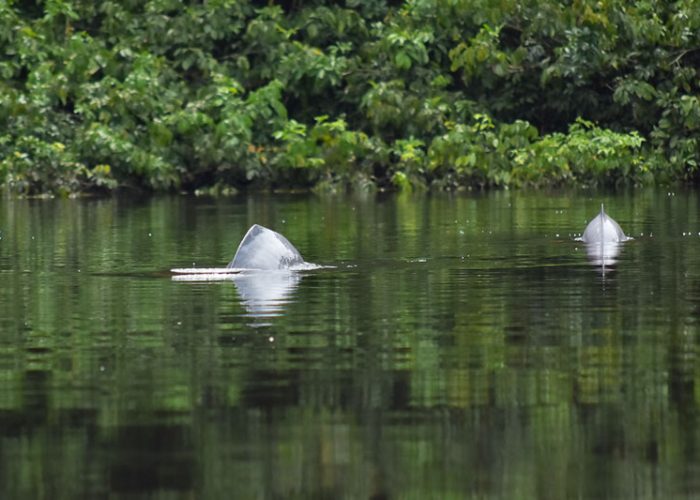
By Day, On the Water
The mornings and the late afternoons on the river and the lagoon belong to the animals that are awake in the light, so that is when you find the pink dolphins surfacing in the calm channels, the squirrel, howler, capuchin and woolly monkeys feeding along the edge of the canopy, and the hoatzins, macaws, toucans and kingfishers sitting out along the banks, with the caimans, iguanas and river turtles out on the branches and the sloths asleep somewhere above them.
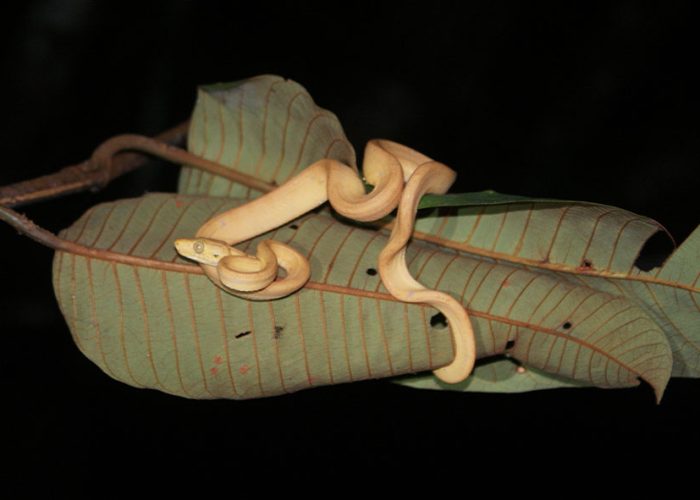
By Night, By Torchlight
The same stretch of water holds a completely different set of animals once it gets dark, which is why we take the canoe back out at night, and that is when you find the spectacled and black caimans lit up in the beam along the shallows, the tree frogs and monkey frogs calling over the pools, the anacondas and boas resting at the water’s edge, and the tarantulas, the stick insects and the occasional potoo along the trail. Both outings are part of a normal trip, because the two of them together are what makes the list long.
When to Come, and for What
December – March
Low Water
As the rivers drop, the animals come down to what is left of them, and the open banks make it easier to see along the edges, so this is the better window for the capybara, the tapir, the black caiman and the turtles out sunning themselves.
April – November
High Water
Higher water opens quiet channels the canoe can paddle straight into the flooded igapó forest, and this is the stronger window for the pink dolphins, the giant otters, the woolly monkeys and the frogs that call all night. A good deal of what people come for is here in every month of the year, so it is worth choosing your season around the animals you most want to see, and you can see how the trips run on our Cuyabeno tours page.
Why These Animals Still Matter
Several of the animals on this page are under real pressure across the rest of the Amazon, and the pink river dolphin and the giant otter are both Endangered, the lowland tapir is Vulnerable, and the jaguar and the harpy eagle are both Near Threatened. Finding them here as regularly as our guides do says something about what this reserve still holds, and it is the reason we pay as much attention as we do to how the tourism around it is run. You can read what we do about that on our Why Tucán page.
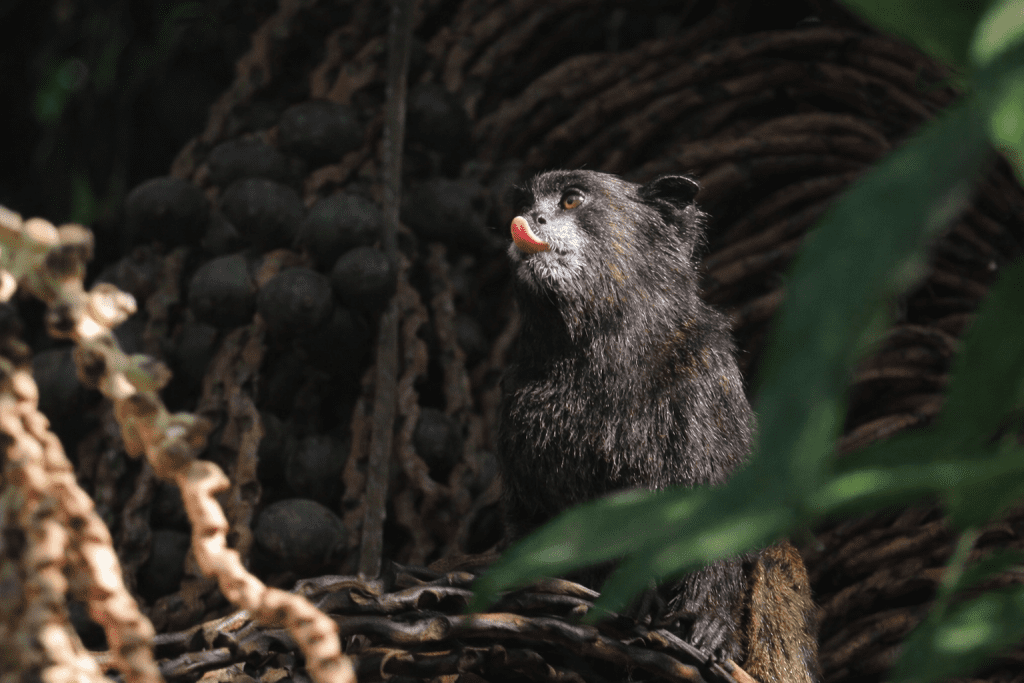
Is Any of This Dangerous?
Much less than people expect, and you are never out there on your own. Most of the animals guests ask about would far rather keep away from you, and the caimans slip off long before the canoe gets close, the anacondas we find are usually resting at the edge of the water, and the goliath birdeater is about as harmless as anything that size can be. Every excursion goes out with a local guide who grew up on this river, so what we ask of you is straightforward: cover your arms and legs at dusk, wear repellent, stay with your guide, and let them point out the few things that are better left alone.
Cuyabeno Wildlife, Answered
The things people most want to know before a trip into the reserve
On the four-day trip, the ones our guides find on almost every departure are the hoatzins, the spectacled caimans, the kingfishers, the toucans, the macaws, the blue morphos, the river turtles and several kinds of monkey, along with the pink river dolphins and, more often than most people expect, a green anaconda. Giant otters, black caimans, potoos and poison-dart frogs come up regularly through the year. Capybara, tapir, ocelot and jaguar are the ones that come down to luck, and the list above gives you a number for each.
Every month is worth coming, and a good many of the animals people come for are here all year round. Low water from roughly December to March opens up the banks and brings the capybara, tapir, black caiman and turtles within easier reach, and high water from roughly April to November lets the canoe get into the flooded forest, which is better for the dolphins, the giant otters, the woolly monkeys and the frogs. Choose your season around the animals you most want to see.
Both, and each gives you different animals. The daytime outings on the water are for the dolphins, the monkeys, the turtles and the birds, and the night canoe is for the caimans, the frogs, the anacondas and the spiders, so a normal trip takes you out for both.
Yes, and they are among the animals our guides find most reliably, usually on the calm deep channels around dawn or late in the afternoon. They are wild animals and we cannot promise you one, though most groups do see them. There is a great deal more about them on our pink river dolphins page.
More often than most people imagine. The green anaconda is one of the animals our guides find most reliably here, usually resting at the edge of still water around dusk or on the night canoe, and it is one of the things guests are most surprised by when they get home.
Probably not. Jaguars live in this reserve and our guides come across their tracks often enough, but on a short trip a sighting comes down to luck, and it is usually the camera traps rather than the canoes that find one.
Much less than its reputation suggests. The caimans, the snakes and the big spiders keep their distance, and every excursion goes out with a guide who knows the ground. Clothes that cover you at dusk, repellent, and staying with your group between them cover almost all of it.
Come and See How Many You Find
Our guides know which tree the sloth was in this week and which channel the dolphins have been working, and that is most of the difference between a good day out here and a quiet one. The four-day and five-day trips give you the most time on the water, and the most chances.
→ See Our Tours