
Two river dolphins, not one | Blackwater rivers and lagoons | Best seen December–March | Critically Endangered in Ecuador
Meet Cuyabeno's Pink Dolphins
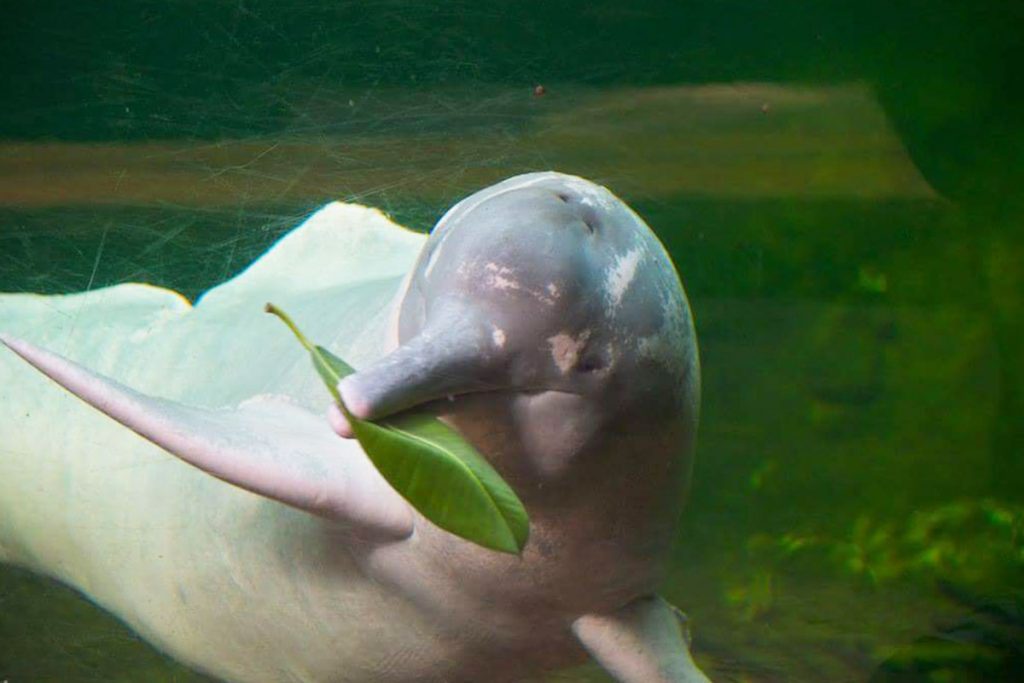
Cuyabeno’s pink river dolphins live at the far western edge of the whole species’ range, in the narrow blackwater rivers of the Ecuadorian Amazon, so the animal you meet here belongs to one of the smallest and most special populations anywhere. Under the naming most scientists use today it is the Amazon boto, and it shares these waters with a second, smaller river dolphin called the gray tucuxi. When people arrive expecting a single cartoon-pink dolphin leaping like something off a postcard, the real Cuyabeno turns out to be more interesting, because there are two species here in the same dark water. You can read more about the waters they live in on our Cuyabeno Wildlife Reserve page.
Why Are They Pink?
This is the question every visitor asks, and the honest answer is more surprising than the myths. The best explanation from the science is that the colour is about age and social life rather than health or magic. Dolphins are born a dark gray, they lighten as they grow, and they turn steadily pinker with age, and the males carry the marks of a rough social life on top of that, because they scar one another and that scarring shows through as pink. So the deep-pink dolphin you hope to see is usually an older male with a history behind him, while the palest gray ones are often young.
The males are not only pinker, they are also much bigger. The boto is one of the most sexually different dolphins in the world, with males running around 16% longer and roughly 55% heavier than females, so a large, deeply pink, well-scarred dolphin is almost certainly an adult male.
Are They Really Loners?
You will read everywhere that river dolphins are loners, and in Cuyabeno that turns out to be mostly wrong. In the local study here, dolphins were seen in groups of two or more more often than alone, and calves were frequently found in loose groups of four or more rather than in simple mother-and-baby pairs. Different corners of the reserve seem to do different jobs for them, too, because the grassy lagoons and the flooded igapó forest hold many of the calves and appear to work as nursery areas, while the wide, shallow, beachy stretches are used more for travelling through. So when you glide into a quiet lagoon, you may be entering the part of their world where the next generation is being raised.
Life in the Dark Water
The boto is built for exactly the kind of place Cuyabeno is. Instead of speed, it is made for maneuvering, with a bendable, unfused neck and large paddle-like flippers that let it turn between sunken trunks, branches and flooded plants, which is worth far more than being fast in a forest that spends half the year underwater.
Seeing in blackwater is its own challenge, so the dolphins rely on sound rather than sight, sending out quick high-frequency clicks and reading the echoes to find their way and their food through the clutter. It is a sensory system tuned for dark, tangled, structure-filled rivers, which is to say, tuned for home.
And they eat well. The boto is a generalist hunter of fish roughly 25 to 90 centimetres long, across more than forty species, with big catfishes among its favourites in this part of the Amazon. Reassuringly, the science does not support the old idea that the dolphins are stealing the fishers’ catch, because what they eat and what people fish for do not line up as neatly as that story assumes.
When and Where to See Them
Cuyabeno’s dolphins move with the water, so timing helps. When the water is high they spread out into the upper rivers, the lagoons and the flooded forest, and become part of a much larger, more scattered world. When the water falls and drops low they gather toward the river mouths and deeper channels, because the shallow upper systems shrink and the dolphins concentrate into less space.
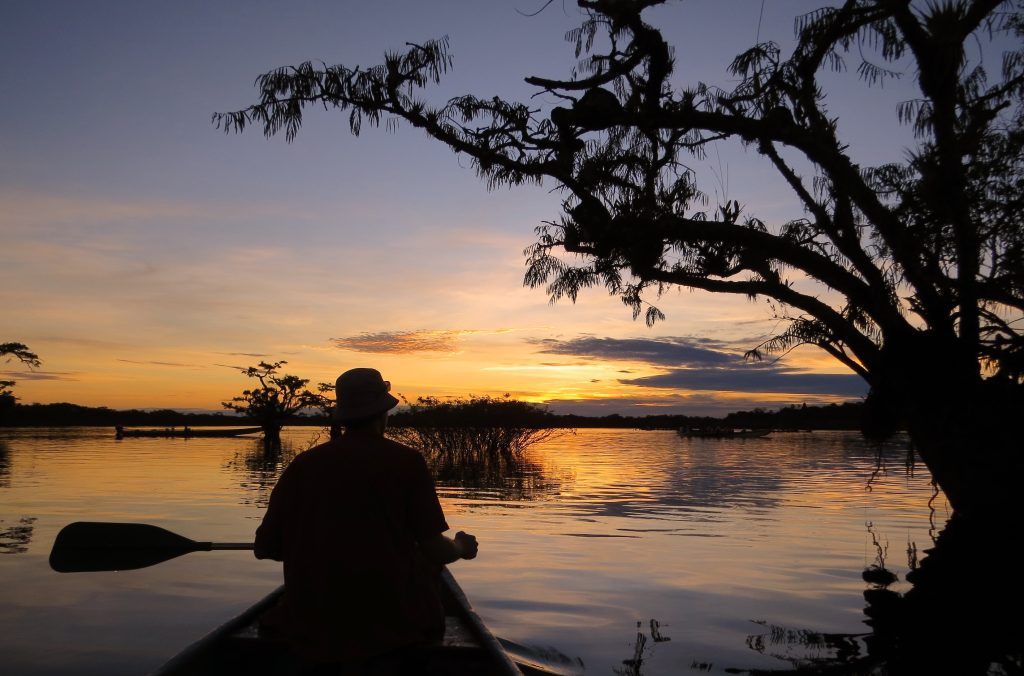
That is why the best window for reliable sightings is usually the lower-water period, roughly December through February and sometimes into March, when the animals are packed into fewer, deeper places and are easier to find from a canoe. Higher water is still wonderful in its own way, because that is when you experience dolphins moving through flooded forest and lagoons, so it comes down to what you are after: lower water for the best odds of a sighting, higher water for the drama of the flooded forest. Either way, searching for them is one of the quiet highlights of our Cuyabeno tours and the activities out on the water.
A Living River, and Why It Matters
For the Kichwa people of the Ecuadorian Amazon, the river dolphin is read as a sign of a living, healthy river, an animal tied to the movement of fish and carrying both ecological and spiritual weight, and that way of seeing them fits what the scientists find, because a river that still holds dolphins is a river that is still working.
It is also a river under real pressure. In Ecuador, both the pink and the gray river dolphins are now considered Critically Endangered, and their biggest dangers are hunting, accidental capture in fishing gear, habitat damage, pollution, climate extremes and poorly managed tourism. Around Laguna Grande, the heart of dolphin watching in Cuyabeno, thousands of visitors come every year, so how those visitors behave on the water genuinely matters.
That is why responsible watching is not a slogan for us. It means keeping a respectful distance, not chasing animals for a better photo, easing off the engine around surfacing dolphins, and being especially gentle around calves and nursery groups, so that the dolphins set the terms and we follow. You can read more about how we try to tread lightly on our Why Tucán page.
Pink Dolphin Questions, Answered
The things people most want to know before looking for dolphins in Cuyabeno
Yes. Cuyabeno is one of the places in the Ecuadorian Amazon where you can see wild pink river dolphins, and it is also home to a second, smaller gray river dolphin called the tucuxi.
The colour comes mainly from age and social life rather than health. Dolphins are born dark gray and turn pinker as they mature, and males become especially pink through scarring from their interactions, so the pinkest dolphins are usually older males.
The lower-water months, roughly December through March, usually give the best odds, because the dolphins gather near river mouths and deeper channels as the shallow systems shrink. Higher water is better for seeing them among flooded forest, though the animals are more spread out then. You can plan around this on our Cuyabeno tours.
You do swim in the same lagoons and rivers the dolphins live in, so every now and then one may surface nearby. They are shy, wild animals rather than a swim-with-dolphins attraction, though, so the idea is to share the water calmly and let them come and go on their own terms instead of chasing them, which is better for you and much better for them.
Less than people think. In Cuyabeno, groups of two or more were seen more often than lone dolphins, and calves were often found in groups of four or more rather than only with their mothers.
There is no recent exact count for the reserve. The best local scientific baseline, from the late 1990s, estimated around sixty dolphins across the Cuyabeno and Lagartococha rivers, and recent expeditions still record them, so it is a small but real population.
Fish, and plenty of kinds of them. The boto is a generalist hunter of fish roughly 25 to 90 centimetres long, with large catfishes among its favoured prey in the Ecuadorian Amazon.
No. Pink river dolphins are shy, curious fish-eaters and pose no danger to people. They spend the day hunting fish through the dark water, and an encounter is usually a gentle thing, a pink back and a breath at the surface before they slip away again.
Come meet them where they live
Our guided tours take you out onto the same blackwater rivers and lagoons the dolphins call home, and our four-day and five-day trips give you the most time on the water and the best chances, especially in the lower-water months.
→ See Our Tours